Corporate, Politics, Reportage, Oktoberfest
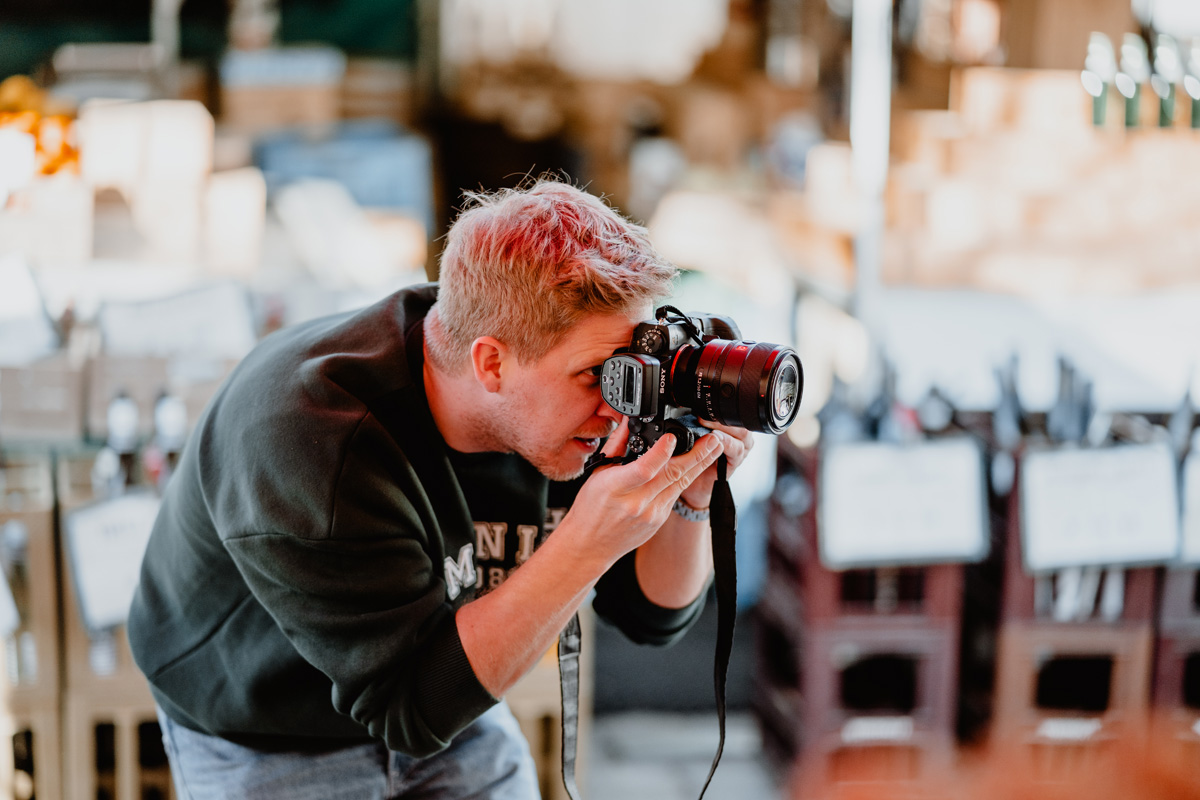
Jan Saurer photographs Munich – and Munich photographs back. For years, the photographer known as Monacoshots has been moving through his city with a camera. His clients range from Siemens to city politics, from Tierpark Hellabrunn to the Munich Security Conference. What drives him is always the same: the person behind the moment.
Q Your clients range from Siemens to Olaf Scholz to the Oktoberfest. What connects these jobs – is there even a common thread?
I think the simplest common thread is that everything ultimately involves people. I genuinely like people and prefer to photograph them in their familiar surroundings, because you can feel that later in the images. Whether it's politics, corporate work or the Oktoberfest – people come across as more authentic when they're moving through a space that belongs to them.
Q Political photography often means: one second, no second chance. How do you prepare for situations you can't control?
I try not to control everything – rather, to be as prepared as possible so that I can react intuitively in the decisive moment. In political photography especially, what matters most often happens between the official moments: a glance, a gesture, a brief loss of composure. Your technique and reflexes need to be solid, but above all your attention needs to be sharp.
Q You have a Leibovitz quote on your website – "I photograph everyone I know." What does that mean in practice when the client is someone you've just met?
For me, that quote doesn't necessarily mean I need to have known someone for a long time. It's more that I try to build a genuine connection within a short space of time. Even when I've just met someone, I'm interested first in the person behind the role or the brief. I believe good portrait photography happens when someone feels seen – not just photographed. So I try to listen carefully, read the mood and create an atmosphere where naturalness can emerge. In that moment I may not have known the person long, but I still approach them with genuine curiosity.
Q Corporate photography has a reputation for being sterile. You talk about emotional storytelling. How do you bring that to a brief where the client has clear expectations?
From the very beginning, I try to show potential partners different ways of approaching what might initially seem like a more conventional or sterile brief – making it feel more contemporary and emotionally resonant. That can start with more authentic employee portraits and go all the way to vivid campaign imagery. What matters to me is that images feel professional but remain human and authentic. Not every image needs to be perfect, but it needs to be credible.
Q Munich is your city and at the same time your biggest client. What do you see in Munich that others overlook?
Many people only see Munich's beautiful surface. I'm more interested in the small moments beneath it – the quiet of the early morning, the quirks of its people, the contrasts between tradition and modernity. That's what makes the city feel alive to me.
Q What was your most difficult shoot – technically, humanly, or for whatever reason?
The most difficult shoots are often the most interesting ones. When chaos breaks out or you feel completely overwhelmed, panic doesn't help. What does help is taking a brief step back, reassessing the situation and reminding yourself why you're actually there and what you want to show.
Not every image needs to be perfect, but it needs to be credible.
Q You photograph the Oktoberfest every year – the same event, over and over. How do you still manage to make fresh images that don't repeat themselves?
I think repetition only happens when you stop looking. At the Wiesn, thousands of new small stories unfold every year – you just have to stay attentive. Those emotions, people and moments are unique, and that's exactly why the Wiesn and the Security Conference are actually my photographic highlights of the year – two completely different worlds, both with an incredible amount to say.
Q Which image – yours or someone else's – has genuinely moved you recently, and why?
I constantly consume images – digitally and in print. Even when I don't have time, I often lose myself in references or photo essays on particular topics. Because I'm currently working a lot in political contexts, the work of Florian Gaertner from Berlin has been occupying my mind. He made a long-exposure photograph of Friedrich Merz and Lars Klingbeil that really impressed me. The image is creative, yet completely documentary and precise at the same time. You can only tip your hat to work like that.
Q What should people feel when they see your work?
Everyone should naturally feel and see whatever they recognise in it – I don't want to impose too much on that. But fundamentally, I try to give every person at least one image they can proudly show their grandmother at the next family gathering. If that happens, I think I've done my job pretty well.