Football, Basketball, Handball, Press Photography
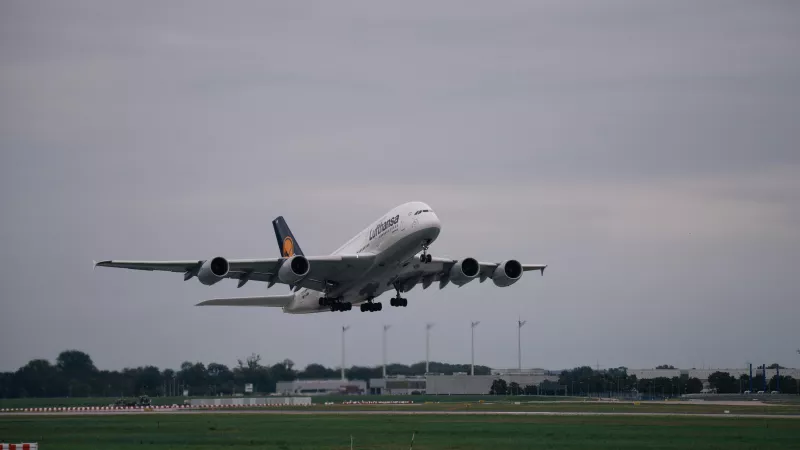
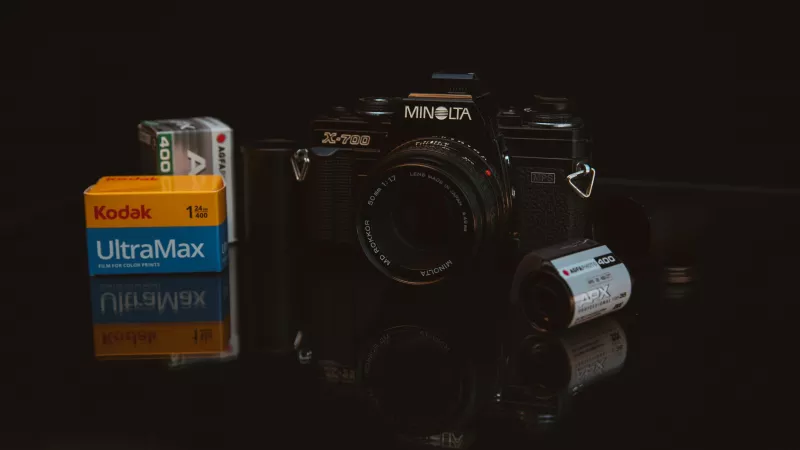
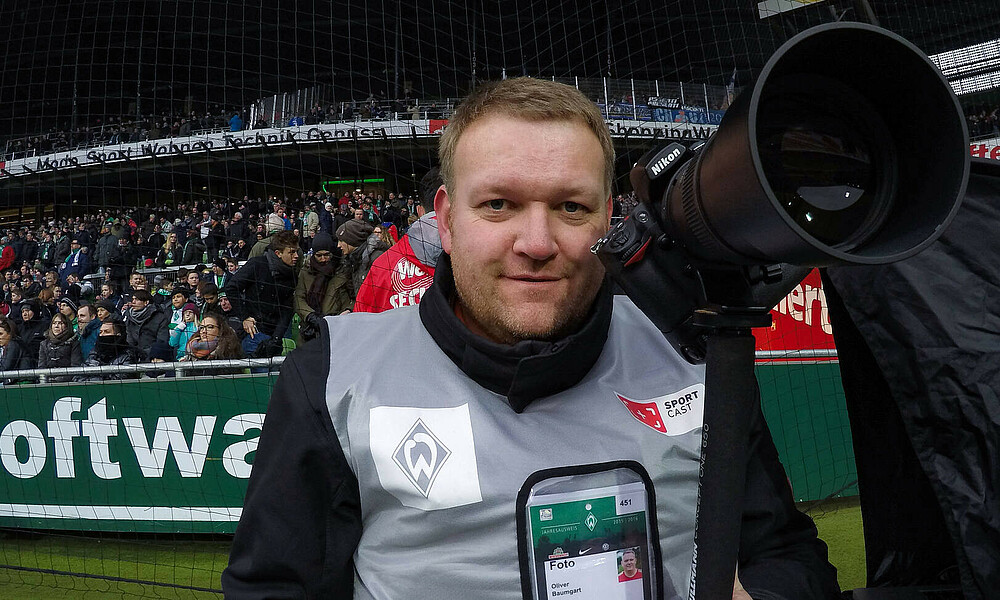
Oliver Baumgart photographs sport — starting with a consumer DSLR, working since 2012 through his photo agency Hansepixx as a press photographer at matches and sporting events across Germany. Bundesliga, international fixtures, European Championships — always in search of the decisive moment. Privately, his passion turns to slowing down: landscapes, architecture, and aircraft — for which he even runs a dedicated website.
Q You started with a consumer DSLR and sports auto mode – and became a Bundesliga photographer. What was the decisive step between hobby and professional?
Honestly, it was never my plan to make photography a career. I simply enjoyed it and used to post my photos in image galleries on Facebook. Then one day, out of nowhere, came the first enquiry from an editorial outlet. And I thought: why not try to make some money from my own pictures?
I started deliberately looking for subjects that the media needed but that hardly anyone was photographing. At the same time, I gradually improved and expanded my equipment. In the end it was more of a gradual process: you keep going, you get better, you get more enquiries – and at some point you realise that you can regularly pay your rent from the income (laughs).
Q Sports photography means: you have to deliver, regardless of rain, bad light or a bad game. How do you deal with it when nothing is working?
Honestly: that situation simply cannot happen (laughs). And these days it barely does, because I've learned from every setback. Whenever a problem comes up, I think very carefully afterwards about whether and how I can prevent that exact problem from bothering me again.
I always have at least one additional camera with me, mobile internet from different providers, and everything that can break or get lost is available in duplicate: memory cards, batteries, card readers, cables and so on.
You can also protect your equipment pretty well from the weather. I remember a football match at the Women's European Championship in 2017 in the Netherlands. We were in Rotterdam for the quarter-final between Germany and Denmark. Suddenly, within no time at all, it rained so heavily that the water was ankle-deep throughout the entire stadium. Frantic attempts were made to clear the pitch of the flood water, which naturally produced some great photo opportunities. Unfortunately no football could be played that evening – the match literally went under. But I was still able to deliver pictures.
Another time, there was a pre-season friendly involving the Bundesliga squad of SV Werder Bremen at a small village club in the countryside. There was absolutely no mobile signal to be had. So at half time I got my laptop, drove to the nearest town, sent my pictures from there, and drove back to the ground to photograph the second half (laughs).
A bad, one-sided or boring game, on the other hand, is never really a problem. Whether it's the Bundesliga or the local league: every game gives you good material. It's just the pace and the external conditions that are different.
Q One day Bundesliga in front of 40,000, the next a village pitch with 17 spectators. Which do you prefer – and why?
These days, I almost prefer the village pitch. Of course there's something special about sitting right on the touchline at a top-flight Bundesliga match. But that magic wears off fairly quickly – at the end of the day, you're there to work. There's not much room for photographic romance.
At the small village clubs, everything is more familiar, more relaxed, more low-key, and usually not as tightly organised as a Bundesliga or international fixture. Working on the touchline is often more casual too, because there are fewer regulations. You can move more freely than in a Bundesliga stadium, you don't sit in traffic on the way home, and the bratwurst often tastes better too.
Q The decisive moment in sport often lasts a tenth of a second. How much of that is preparation, how much instinct?
Rather than preparation, I'd talk about experience. As different as matches can be, certain situations keep repeating themselves. Over the years, a lot of things become second nature. At the same time, instinct is of course part of it too. You try to anticipate situations as early as possible. Unlike portrait photography, for example, in sport it's usually not the photographer who determines the subject – it's the players on the field.
Specialist knowledge can also help sometimes. I once did a referee's course, and that can genuinely be useful. You can recognise earlier, for example, that a red card might be coming in a particular situation.
One example: in 2015 I was photographing the DFB-Pokal match between VfL Osnabrück and RB Leipzig. About 20 minutes before the end, the referee was hit on the head by a lighter thrown from the stands. While many of my fellow photographers looked at each other wondering what would happen next, the referee in me knew: really, there can only be an abandonment. When it was announced, everyone started frantically taking photos – while I had already sent my pictures on their way.
These days, I almost prefer the village pitch.
Q As well as football, you also cover basketball and handball – each sport has a different dynamic. What changes in your head when you switch between them?
Actually not that much, because the workflow doesn't fundamentally change either. Handball and basketball are, in my view, very dynamic and fast-moving sports with almost no downtime. But in football too, you can't switch off during the game, because something decisive can happen at any moment.
When I started trying other sports alongside football, I was actually surprised by how similar the photography feels in the end. The processes, the observation, the anticipation – much of it is comparable.
With indoor sports, more technical challenges come into play. Unfortunately not every sports hall has broadcast-quality lighting. So you work more often with high ISO values and tricky white balance settings. On the plus side, at least you're sheltered from wind and rain (laughs).
Q AI and intelligent autofocus are changing sports photography dramatically. Does it make your job easier, or does it take something away?
I use AI more for organisational things than for the photography itself. I get support, for example, with creating squad lists that I need for captioning my images. What used to take half an hour can now sometimes be done in a matter of seconds. That's already an enormous step forward.
At the camera, I do make use of eye-AF, though that's hardly new territory anymore. Beyond that, I actually photograph largely without AI. For me, AI is currently above all a tool that speeds up processes and takes care of work that's only indirectly related to the actual photography.
Q You also photograph a lot privately, and in completely different areas from sport. What does that give you that sports photography can't?
Above all, a slower pace. When I see an architecturally interesting building or a statue, I can take my time finding the best angle and also play around with different exposures. That's not possible in sport. There, the subject is often gone in a fraction of a second and won't come back in quite the same way.
A second point is the post-processing. My sports pictures need to represent the situation as faithfully as possible. With my private photos, on the other hand, I can experiment more freely – convert an image to black and white, for example, or deliberately reduce it to a particular colour.
Q Which image cost you the most – patience, pressure, nerves?
Honestly, I find matches where a title is decided particularly demanding. The emotions afterwards undoubtedly deliver great subjects and powerful images. At the same time, you really have to discipline yourself to send those images out promptly. It doesn't help anyone if you try to capture absolutely everything but the photos only arrive at the editorial desks hours later.
In those moments you're not just collecting great images – you also have a job to do. That balancing act between "I'll just grab this one more shot" and "I really need to send something now" is sometimes hard for me.
Otherwise, you shouldn't put too much pressure on yourself. If you miss a photo because you were busy processing images, a player was in the way, or you simply missed a moment – that's annoying, but it can't be changed. If you dwell on it too long, you're only distracted and might miss the very next moment. You have to accept that in football especially, with its vast pitch, you simply can't catch everything anyway.
Q Which image – yours or someone else's – has genuinely moved you recently, and why?
I'm from Bremen and accordingly spend a lot of time at SV Werder Bremen's home matches at the Weserstadion. What Werder's club photographer Peter Balthazaar does with his camera around those games is quite sensational.
He manages to convey both the action on the pitch and the emotions within the team and in the stands with great immediacy. On top of that, there are always special perspectives and powerful still lifes from around the stadium. His pictures are ones I very much enjoy looking at.
Q What should people feel when they see your work?
As a press photographer, my primary obligation is of course to deliver what the media needs. That is first and foremost a task that has to be carried out reliably.
On my website, I also put the images in galleries for everyone to look at. There, I want my pictures to bring the action on and off the pitch to the screens of visitors – from a perspective that the average fan doesn't normally get to see. Ideally, people recognise themselves in them, relive a moment, or get a glimpse of something that might have passed them by when they were there in person.