Street, Portrait, People, Workshops, Podcast
David Nienhaus photographs people – on the street, at events, and in moments that others overlook. The camera has been his companion for as long as he can remember. His home is the Ruhr region – but under the name "ruhrpoet," his stories in words and pictures reach far beyond its borders. Through workshops and his own podcast, he shares his knowledge and passion.
Q You say you've always thought in photos and frames. Was there still a moment where thinking turned into real doing – where you realized: this is more than a hobby?
"Always" is perhaps not quite right, because photography is something we constantly have to practise – training and challenging our eye, learning to read light, to perceive colours. But yes, I've been learning photography for a very long time and I'm always happy when I notice developments in myself. Among my friends, I was always "the one with the camera" – whether analogue, digital or with a camcorder. For me it was always valuable to capture moments, to give special instants a kind of eternity.
And when did it become more than a hobby? When I realized it's my yoga – my way of switching off, slowing down, staying present in the moment. When the first paid commissions came in, when people started booking me for my storytelling and my look, it became more than a hobby on paper. Either way, photography is something I need to be happy.
Q You come from journalism. Does that change how you see through the viewfinder – do you see moments differently from someone who "just" photographs?
That's hard to answer. I don't think one is better, worse or more different than the other. What I can say is that journalism helped me think about photos holistically – to let images tell a story. To think in terms of reportage and documentation, to pay attention to details.
Q That's why you call yourself a "storyteller," not a photographer. What's the difference in practice?
I have great respect for all colleagues who studied photography or completed formal training. The title belongs to them. That might sound a bit pedantic – but I love the word "storyteller" because it beautifully captures everything I am and everything I bring to my work. A storyteller takes you by the hand into another world, into a special moment, into something that – at best – stays with you.

Q Street, portraits, people – you always work with people. What happens in the moment when you ask someone if you can photograph them – or when you don't ask?
This question always comes up in my workshops too. First: I love photographing people – they're what make the story for me. But the advantage of documentary photography is that I'm not just photographing people, but also the scenes, surroundings and details that carry the story. Now to your actual question: the moment I approach someone on the street, the story changes. Street photography suddenly becomes a street portrait – the moment is no longer authentic, it's staged. That doesn't have to be worse, but it is different. So I always weigh it up: does the scene need to stay authentic – or are we together creating a new, different kind of authentic moment?
Q You shoot analogue and digital deliberately. What can analogue do that digital can't – and vice versa?
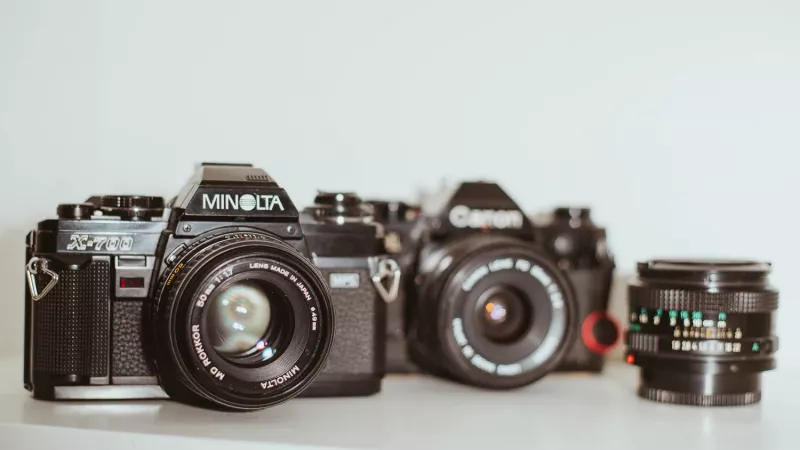
Ah, analogue photography… I do it far too rarely. I have at least one analogue point-and-shoot with me on most jobs – but it often stays in the bag. It's perhaps like all the other equipment I own: it pulls me out of the situation when I'm in flow. But this year I've committed to shooting more on film again – and I already know I want to start developing again too. Analogue photography definitely has something that slows you down.
Q You're the Ruhrpoet – the region is right there in your name. What makes the Ruhr Valley so special photographically for you?
The people! I love the people of the Ruhr Valley, their history and their stories. It's so diverse here, so open, so close and real. Let me be bold about it: the Ruhr Valley is New York, Istanbul and Tuscany – but with its own character. I'm a huge fan of the industrial culture here, the fact that old collieries and great halls become cultural meeting places, that spoil tips become landmarks, and that between nature and urban spaces there's so much room for creativity.

Q You pass on your knowledge – I was at one of your workshops myself. What do you still learn from them?
So much. I try not just to share knowledge but to develop creativity and perspectives together. People are as different as photography itself. We all perceive the world a little differently. I love it when I leave a workshop with fresh thoughts and ideas – I always write them straight into my notebook.
Q Which image has cost you the most – emotionally, not technically?
There have been many recently. Last year I had the privilege of accompanying the Gerald Asamoah Foundation for Children with Heart Disease to Accra, Ghana. Even though I was well prepared – everything was more intense, more emotional, more immediate than expected. I was allowed to witness and photograph open-heart surgeries in the intensive care unit. An eight-month-old girl lying there, surrounded by six doctors and many others whose work was giving this tiny person a life. I'm deeply grateful to have experienced that – and truly happy that with my photobook "Through the Window – Accra in Motion / Inside the Heartwork – Healing in Accra" I was able to give something back. We've now printed a second edition.
At the beginning of May, we had a beautiful exhibition opening at the Pauluskirche in Bochum, which was attended by so many friends, acquaintances, and interested people. It truly touched my heart. If any of you are interested in the book: I still have a few remaining copies available in exchange for a donation to the 'Gerald Asamoah Foundation.'
A storyteller takes you by the hand into another world, into a special moment, into something that – at best – stays with you.
Q Which photo – yours or someone else's – has genuinely moved you recently, and why?
I don't need to think long about that. It's a photo I didn't take myself, but one where I was working as head of social media. At the Socca World Cup in Essen in 2023, one of the Ukrainian players happily hugged and kissed his daughter in the stands after a match. Basti Sevastos took the picture – and behind that image lay so much history, emotion, love and tragedy. We later interviewed the player as part of a film and I broke down crying after the conversation. I can still feel that pain – and that joy – today. To hear more, check out episode 85 of my podcast, 'What’s the Story – der Fotografie-Podcast,' where Bastian and I dive into the topic.
Q What should people feel when they see your work?
Curiosity is something I love. Emotions too, of course – but not every photo always triggers emotions, and we have to be honest about that. But when people linger over my photos, when they're curious about the story behind them, the person, the light – that's beautiful to me. And the people I photograph should feel seen. The best compliment I ever received after a shoot: the model had tears in their eyes and said they had never felt so truly seen. I still get goosebumps from that today.